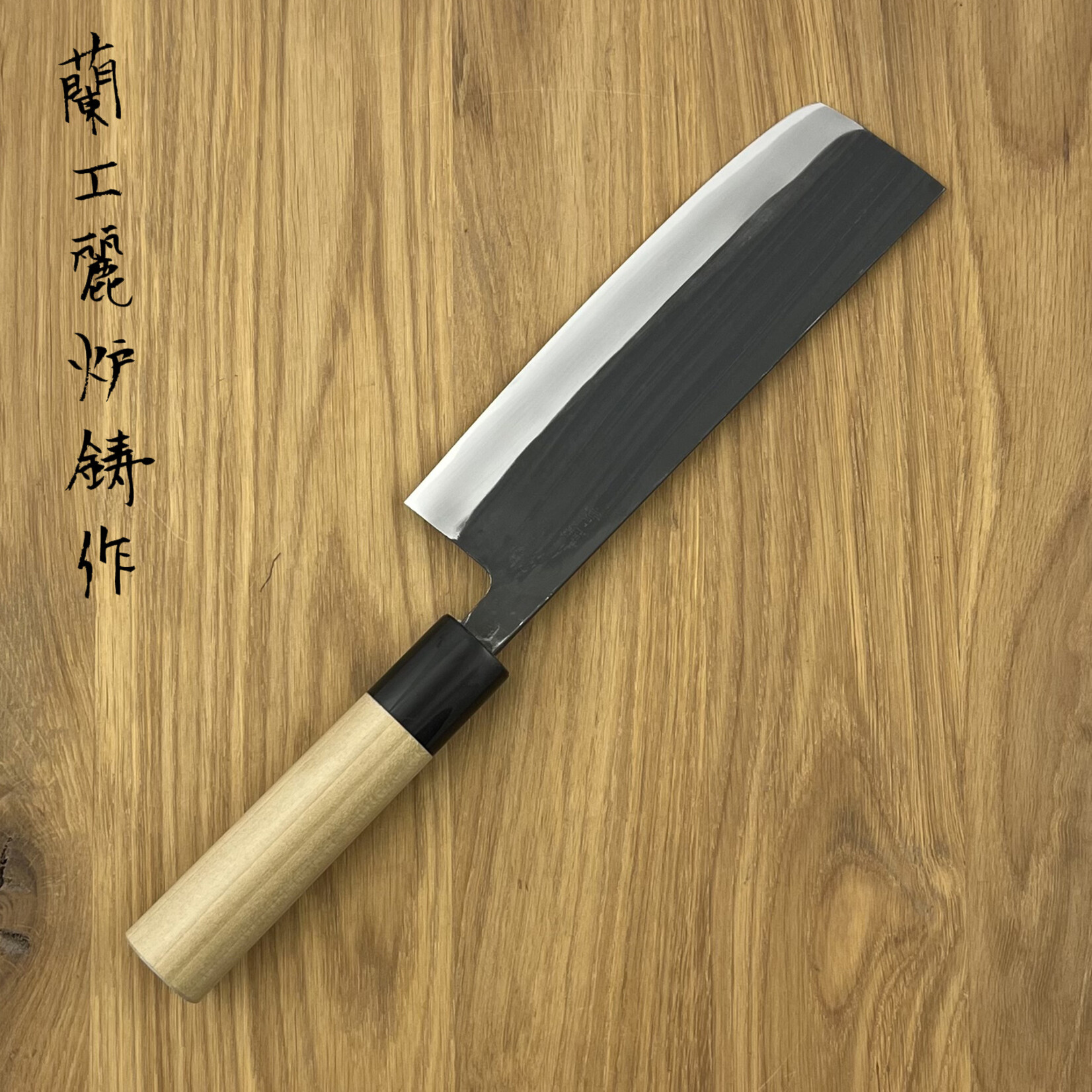
Nakiri • 165 mm • Blue #2 • Oval handle of magnolia with bolster of horn • for both left and right handed use
Features of Masamoto
What makes Masamoto knives so special? They are light, perfectly balanced and sharpened really thin. This ensures a razor-sharp knife that feels super refined when cutting. Especially with precision work, such as sashimi or fine cutting, a Masamoto really comes into its own. They are not robust workhorses, but precision tools for people who like to cook with care and feeling.
A Masamoto knife requires a little attention and technique, but those who work with it often don't want anything else.
Blue steel, also known as Aogami/Aoki steel
This traditional steel is not named after its colour, but named after the colour of its paper wrapping, in which it is stored in the Hitachi steel factory in Japan. There are three different grades: super, #1 en #2. Blue steels use a high grade of carbon, chrome and vanadium added in their alloy. Aogami super even added extra tungsten. Aogami super is here " Best of both worlds" Blue #1 is for sharpness, Blue #2 for toughness. Blue steels are mostly seen in deba or usuba knives, white steels often in yanagibas. Aogami super is regarded as one of the best traditional steels by Japanese knifemakers, but difficult to work with. Blue steels are difficult to sharpen on a whetstone, but they remain sharp for a longer period, compared to white steels.
Elwin de Veld about Masamoto
It is not easy to knock on Masamoto's door and just place an order. By chance, my letter was answered and we were allowed to come and make an audience. This family business has existed for more than 150 years. Now with Shodai san, will serve as the 8th generation. It turns out that Masamoto came to Tokyo at the end of the 20th century and was the first knife maker to introduce takohiki into Japanese cuisine. The yanagiba came later. It seems as if time has stood still in Masamoto's showroom, the company has been in the same place in Tokyo for more than 130 years.