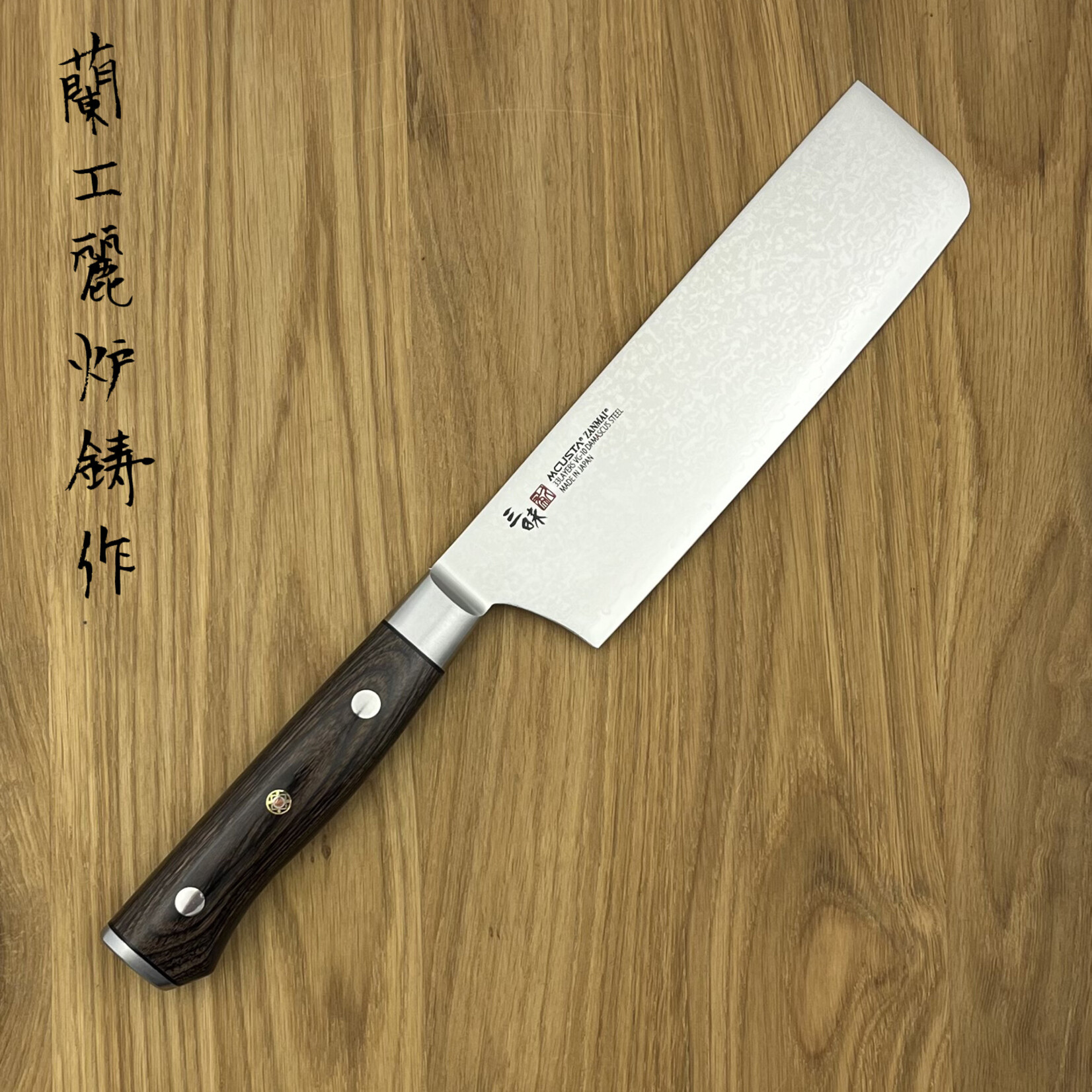
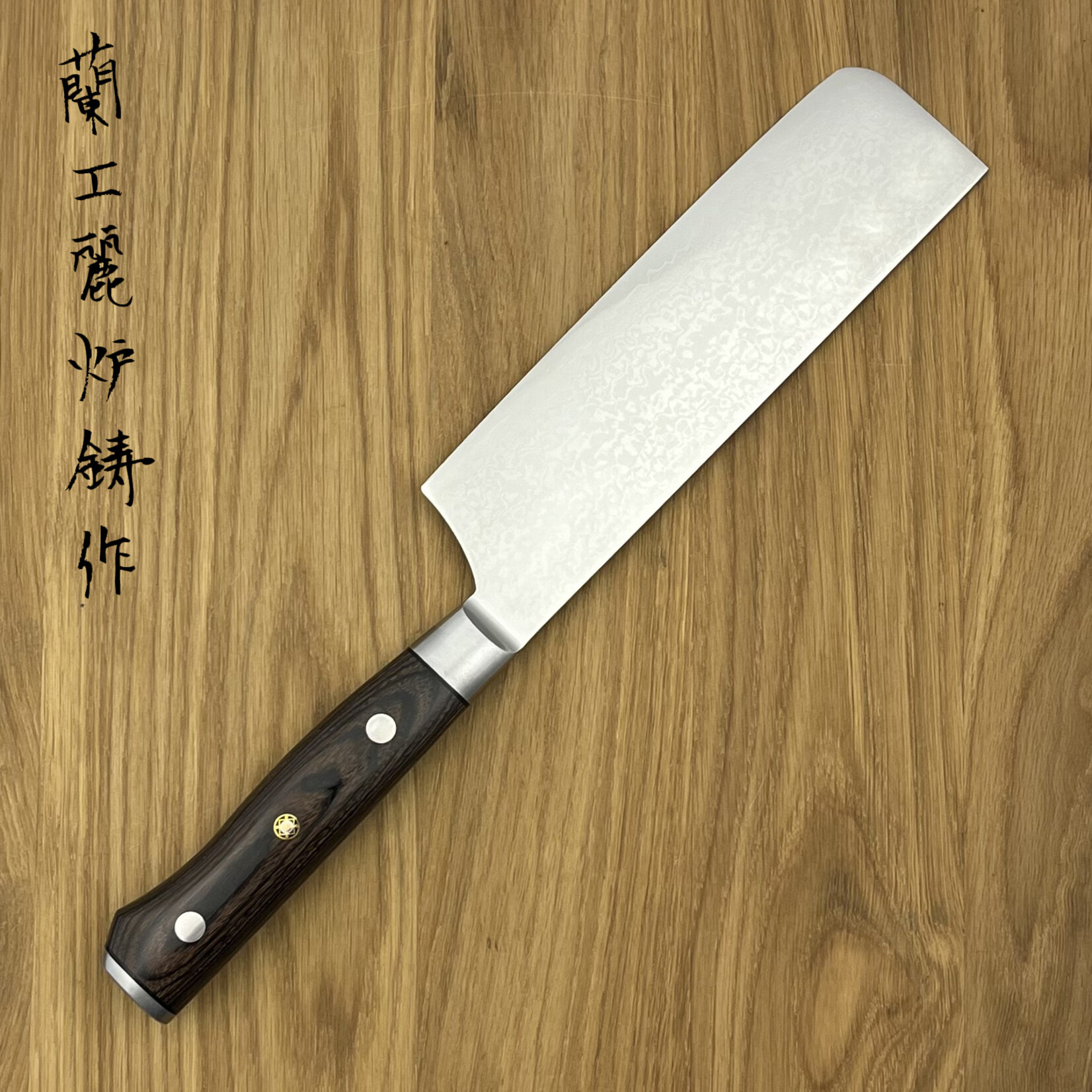
Nakiri • 165 mm • Dark Pakistani wood with mosaic pin • 33-layer VG10 • Japanese Western-style handle • suitable for both left- and right-handed use
Characteristics of the Zanmai Classic Pro Series
Tomo, the owner of Zanmai, creates this Pro series especially for us, featuring a dark wooden handle. Combined with black fillers, the wood gives the knife a warm yet elegant appearance. The handle is beautifully rounded and polished, providing excellent tactile feedback. Wood in general is very pleasant to use: it does not become slippery easily and maintains a consistent temperature. I am particularly proud to offer this series.
The Classic Pro series features a VG10 steel core, clad in 32 layers of matte stainless damascus steel. The blade is relatively thin with a medium to light weight. It offers excellent hand feel, thanks in part to the ergonomically shaped handle designed specifically for Western hands. The refined mosaic pin adds a luxurious finishing touch: ZANMAI.
The combination of balance, hand feel, and an extremely thin and sharp cutting edge results in exceptional cutting comfort. After forging and thinning, the VG10 steel is hardened through rapid quenching. This creates the ideal balance between hardness and toughness, allowing the blade to be sharpened to a very high level while maintaining its edge for a long time.
VG10 – Takefu Steel
Very Gold 10, commonly known as VG10, is one of the most widely used steel types in today’s knife market. It is produced by Takefu Special Steel in Echizen, Japan. VG10 is favored by both makers and users for its excellent balance between performance and ease of use.
It is a stainless steel with a high carbon content, alloyed with elements such as chromium, molybdenum, vanadium, and cobalt. Chromium provides corrosion resistance, while vanadium contributes to wear resistance during intensive use.
Although VG10 is widely used, there are clear differences in quality and performance. During production, various techniques can be applied to refine the steel’s structure and hardness. Factors such as alloy composition, heat treatment, and quenching play a major role. Additionally, the skill and experience of the knife maker in grinding the blade are crucial for achieving optimal sharpness and cutting performance.
At Rangelrooij Sharpening, we are great fans of VG10 steel. It can be sharpened to a very high level and retains its edge for a long time. Despite the wide availability of VG10, we always pay close attention to blade geometry as well. Both are essential and reinforce each other—something our makers clearly excel at.
Elwin de Veld on Mcusta Zanmai
The president of Zanmai, Tomohiro Hasegawa, is relatively new to the world of kitchen knives. Mcusta has existed for over thirty years but originally focused on pocket knives and scissors. Over the past decade, however, they have firmly established themselves in the kitchen knife market. All the knowledge and expertise the company had accumulated was immediately applied to their new kitchen knife production line—modern, precise, and utilizing the latest high-end materials.
Tomohiro-san is my classmate—at least he would be if he had been born in the Netherlands or I in Japan. We call each other classmates nonetheless. Today, around 35 people work in the factory, and Tomo-san is the president of a knife brand that strongly positions itself at the very top of the market.
ZANMAI!