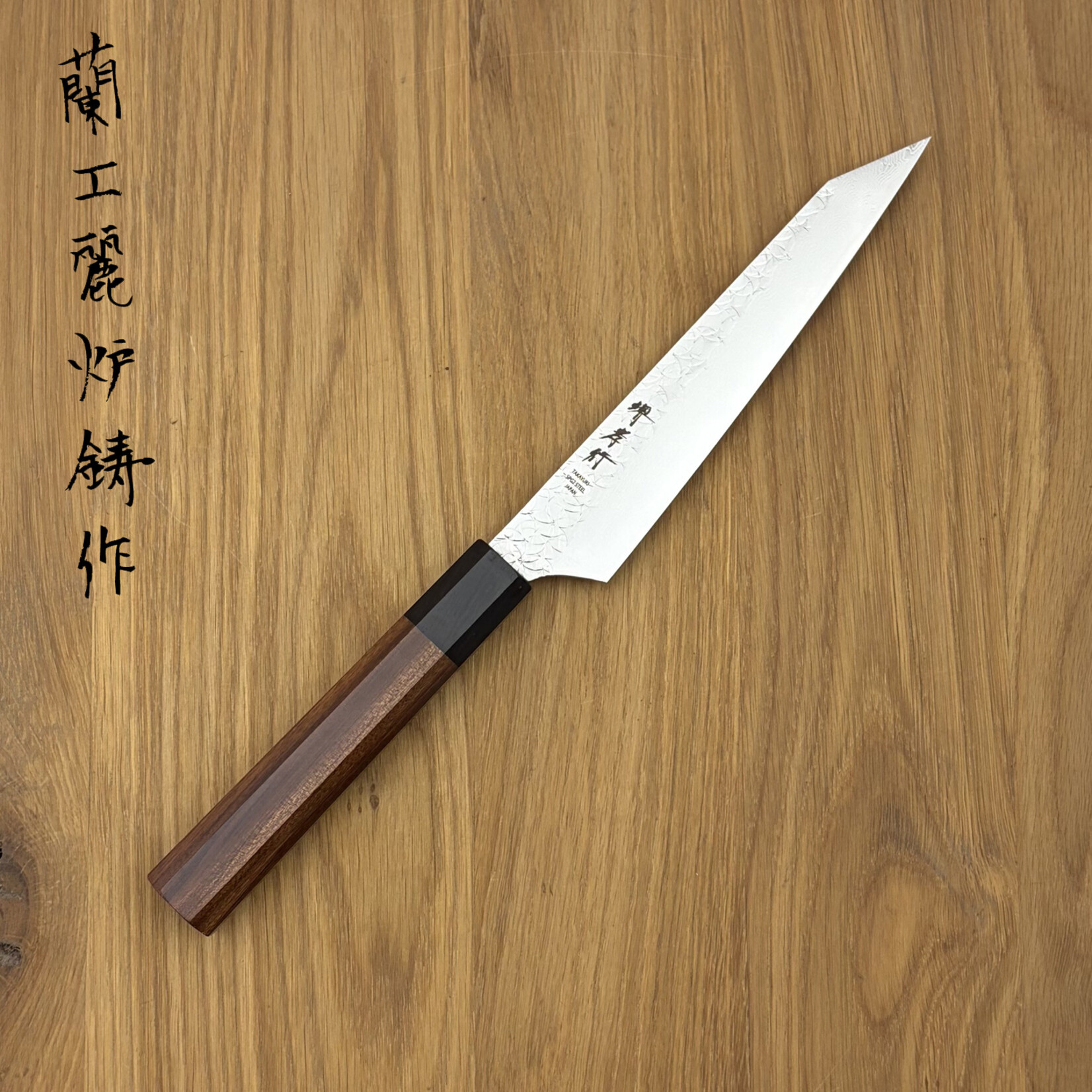
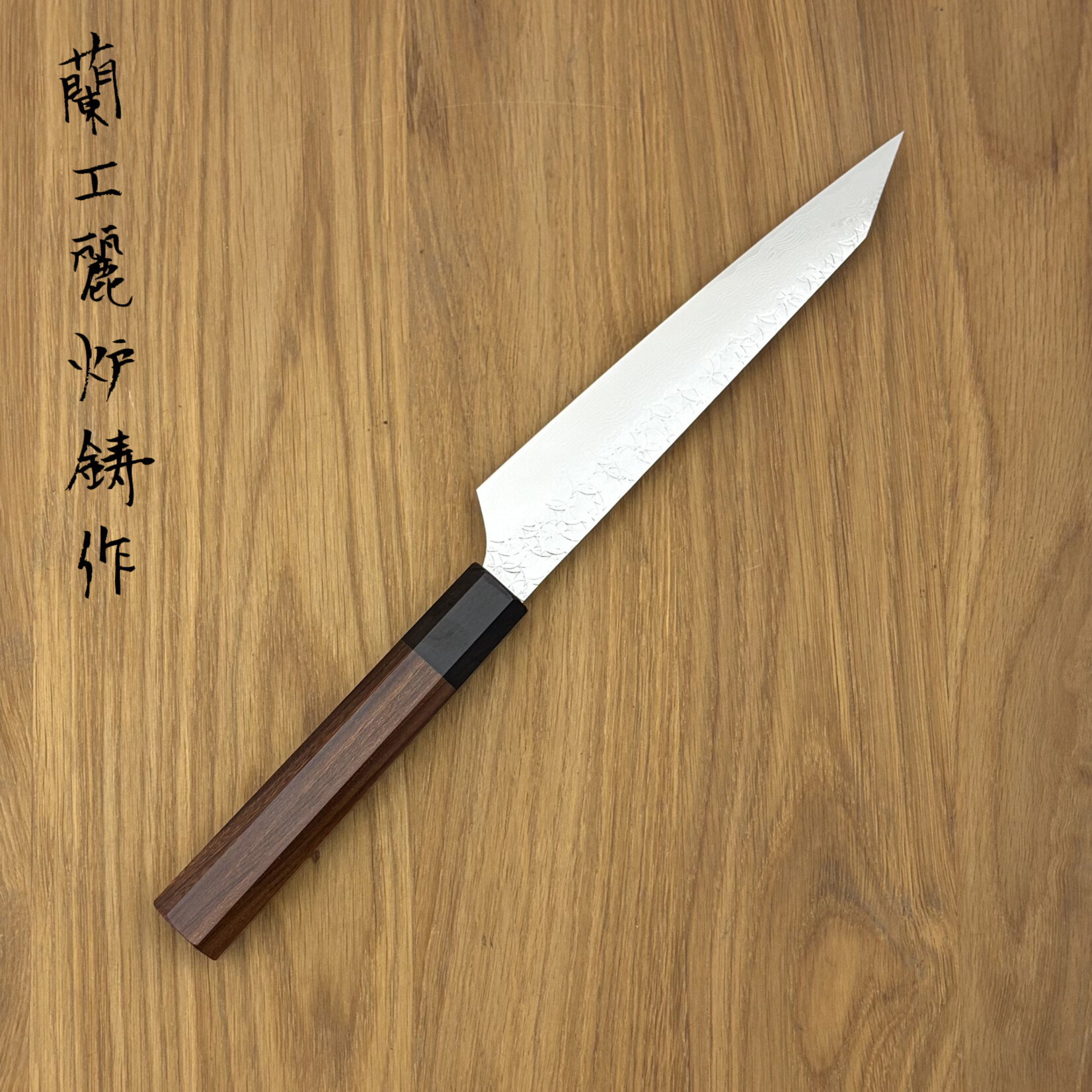
Petty • 150 mm • SG2 steel • quince handle • for both left and right handed use
Features of Takayuki SG2 series
The handle is made of quince and is slightly thicker and heavier than an average Japanese handle. Because the handle is somewhat heavier, the balance point of the knife is also somewhat more towards the middle.
The core of the blade consists of SG-2 steel, also known as powder metallurgy steel, supplied by Takefu steel in Fukui. The SG-2 steel is hardened in a salt bath after forging, which results in the right hardness and toughness of the steel, which can not only be sharpened very sharply, but also remains sharp for a very long time.
SG2 Steel / Super Gold 2 / SPG2
SG2 steel is the big brother of the well-known VG10 steel from Takefu Special Steel. It is significantly harder (62–64 HRC), while still offering the advantage of being fully stainless. Thanks to this high hardness, knives can be ground thinner and retain their sharpness for a longer period of time.
While VG10 is produced by melting raw materials such as iron ore, vanadium, and molybdenum together, SG2 is a powder steel. This means the ingredients are first processed into a fine powder and only then fused into steel. This process results in a much finer and more uniform structure, with molecules packed more closely together, which contributes to the steel’s high hardness.
SG2 is a premium steel, and that also comes with certain drawbacks. Due to its high hardness and very thin grind, the steel is relatively fragile (prone to chippin). Proper cutting technique and careful maintenance are therefore essential.
In summary, SG2 is an exceptional steel for those seeking a stainless steel knife with extreme sharpness that can also be maintained for a long time.
Elwin de Veld about the knives of Sakai Takayuki
We usually start our trips to Japan in Osaka, from where we take a Shinkansen ( a bullet train) to Seki, in Gifu prefecture. We start in Sakai, in south of Osaka, where we always recieve a warm friendly welcome from Aoki san and Ogawa san from Sakai Takayuki. In recent years the customers in our shop have been asking for special Japanese traditionally forged knives: Yanagiba, Sakimura, Kengata: all the names of models which are used in Japanese kitchens for preparing various sorts of fish. Sakai Takayuki is my key which opens the door to the world of traditional Japanese knives and to top it all, their product range is targeted for the western market. For making of the traditional Japanese knives Sakai Takayuki employs the best of the best: Itsuo Doi and Kenji Togashi, among others. The blacksmith Yamatsuke san, with his stable hand on the Kaiten Toshi (Japanese water stone), is a guarantor of an exceptionally sharp finish. Sakai Takayuki buys lots of their steel from the Aichi steel (their headquarters are situated close to Nagoya) and works among other with carbon steel shirogami white and aogami blue. A nice detail: the colours in the names of the steel have nothing to do with the colour of the steel itself- it's just the colour of the packing in which the raw steel is being stored in the factory. The western models are manually finished at the company's quarters in Osaka (sharpening), but largely manufactured in Seki, in Gifu prefecture. The finish and the quality is sublime- just what we can expect from Takayuki.