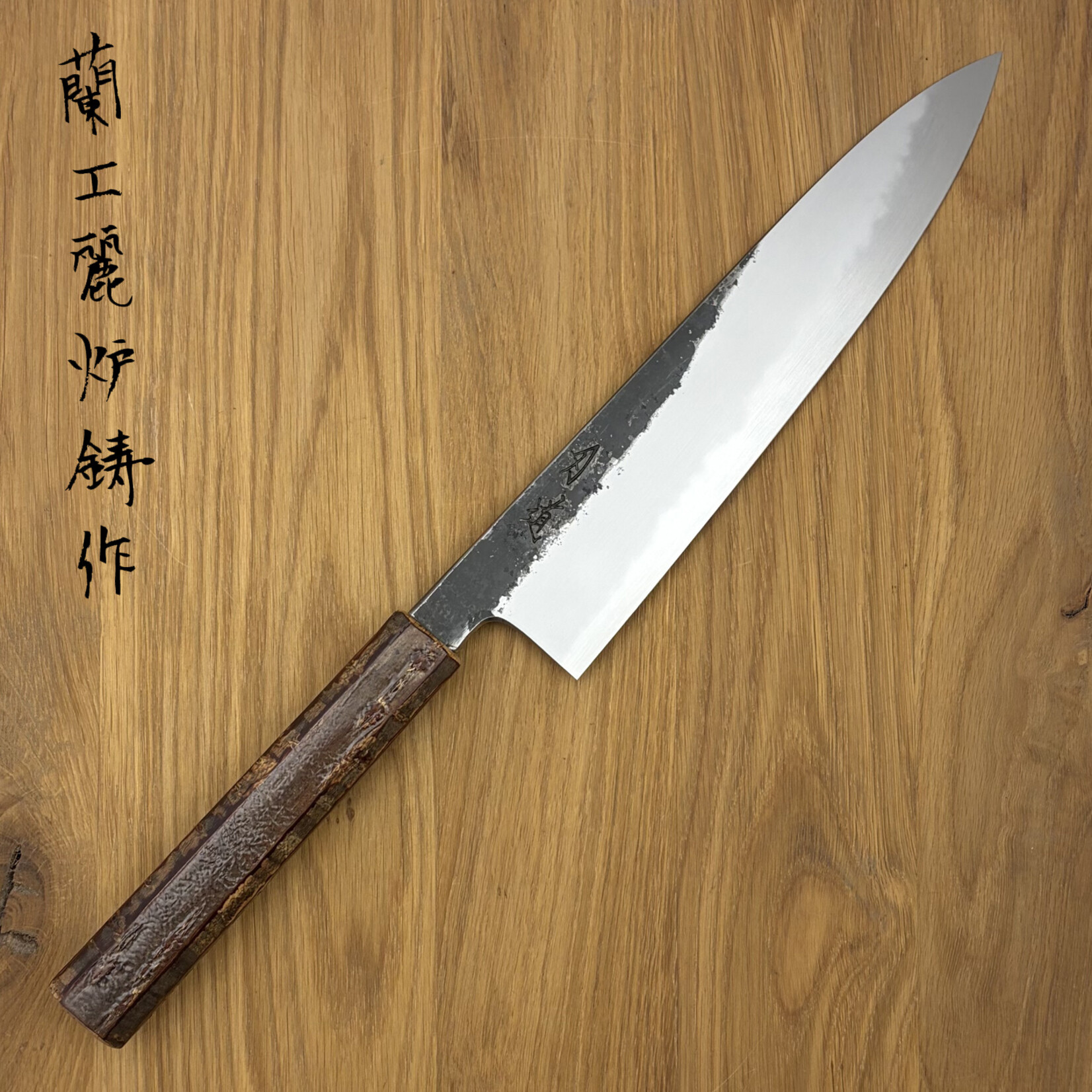
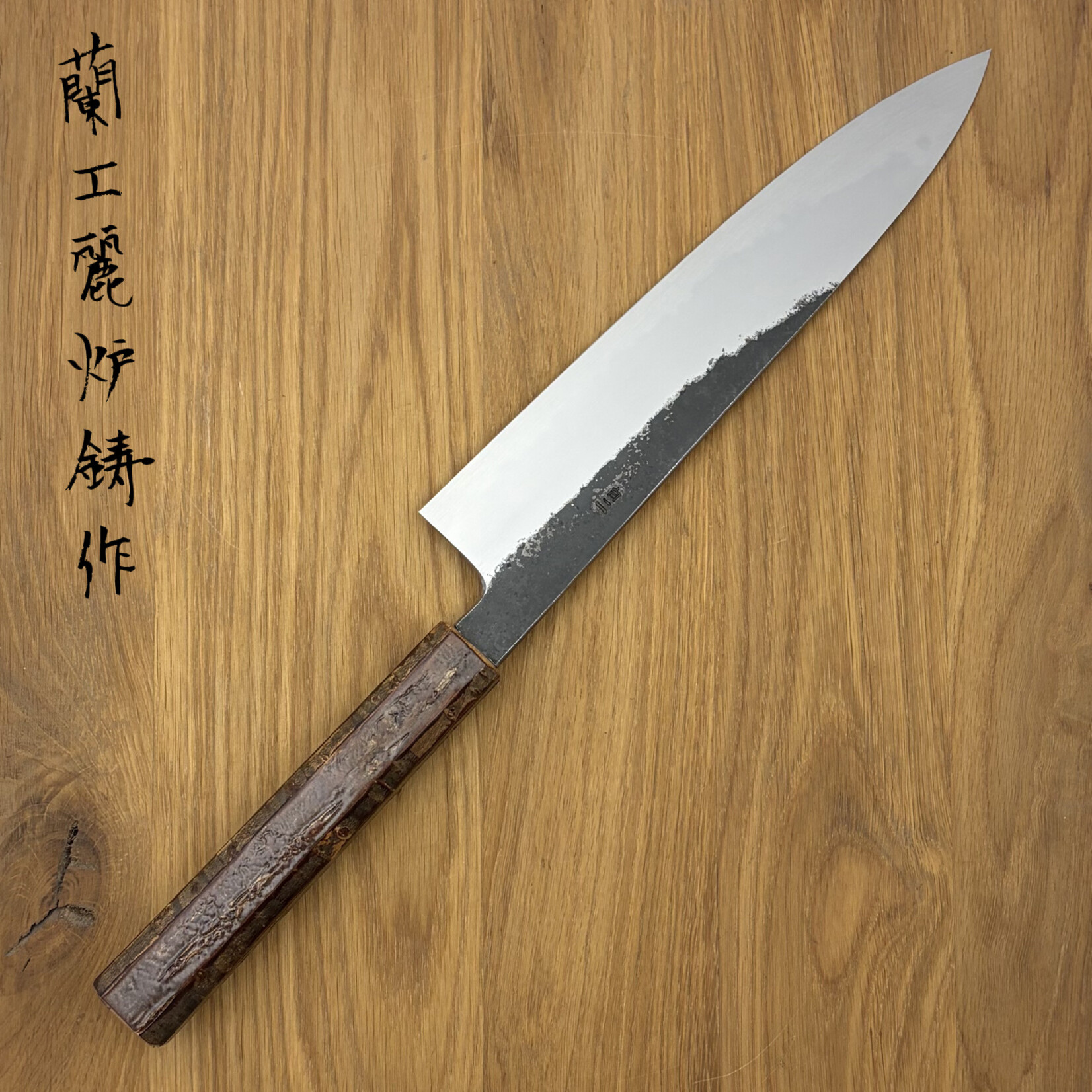
Gyuto • 240 mm • White #2 kurouchi • Japanese octagonal Cherry bark handle • double bevel for both left and right-handed use
Features of the Hado Sumi Series
Hado knives are produced in Sakai, the Japanese city renowned worldwide for its high-quality kitchen knives. Hado is a relatively young company, founded in 2019 under the leadership of President Ryuichiro Fukui.
The blades are forged by master blacksmith Yoshikazu Tanaka, a highly respected craftsman and fourth-generation blacksmith. Another well-known name within the Hado team is Tadataka Maruyama, who is celebrated for his refined geometry and sharpening techniques. Although Maruyama recently started his own business, he still spends one day per week at the Hado workshop, helping to train the next generation of sharpeners.
"Sumi" translates from Japanese as "black ink." This name is reflected in the blade's dark kurouchi finish, also known as a blacksmith's finish. The knife features a three-layer construction with a core of Shirogami #2 (White Paper Steel #2). Thanks to its ultra-thin convex grind, the knife offers an exceptionally smooth and enjoyable cutting experience.
Sakura Bark Handle
The handle is crafted from sakura-kawa (cherry bark), a traditional Japanese material used in Kabazaiku, a craft originating from Akita Prefecture with a history spanning more than 200 years.
Cherry bark is known for its dense fiber structure and excellent resistance to moisture, making it well suited for everyday kitchen use. However, we recommend avoiding prolonged exposure to water. If the handle becomes wet, simply wipe it dry as soon as possible.
With regular use, the bark will gradually develop a deeper color and a natural luster. Over time, each handle acquires its own unique character, creating a beautiful patina that reflects years of use and craftsmanship.
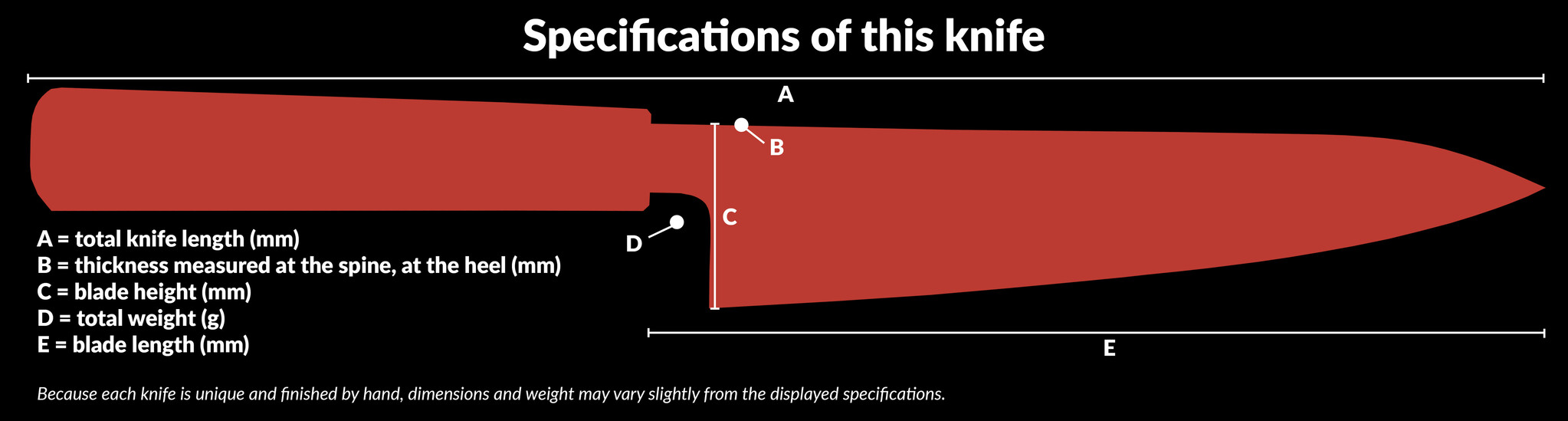
A = 390mm B = 4.0mm C = 50mm D = 208 gram E = 240mm
White steel, also known as: Shirogami/White paper/Shiroko steel
This traditional steel is not named after its colour, but named after the colour of its paper wrapping, in which it is stored in the Hitachi steel factory in Japan. There are 3 grades of Shirogami white steel: #1,#2 & #3. From these 3, #1 contains the highest amount of carbon and #3 the lowest. Generally we say at our knifeshop, grade #1 can be made extremely sharp, but will be a little more fragile as #3. While #3 is a little softer, also easier to resharpen, but has less edge retention. Grade #1 & #2 is most common in white steels. White steel is a refined steel with a low percentage of iron, loved by many, as it is relatively easy to maintain. In practice it can be maintained with a whetstone and in a short amount of time it will become very sharp. This does not mean that these knives never have to be resharpened by a professional, even all knives in Japan need to be refurbished at a certain moment. This Shirogami steel is embraced by sushi chefs who demand extreme sharpness of their knives. White steel oxidates relatively quick and therefore needs to be maintained more often, but on the other hand you will get all benefits of this beautiful steel characteristics.
Elwin de Veld about HADO
The young craftsmen of HADO produce knives in tradiotional shapes and sizes. Traditional Japanese knives with double bevel, extremely hard to make but, if done as well as HADO does, extremely sharp edges. HADO is for now available in 3 series : white #2 kurouchi series (SUMI ), Ginsan with stainless clad ( Ginsan ) and White #1 with stainless clad ( Junpaku ). Where this last series is a rare combination. First of all, white #1 is difficult to forge, even harder with a stainless clad. Tanaka san is the master bladesmith behind HADO knives and produces these rare blades: Comfort of a stainless blade in combination with the extremely sharp white #1 core.
As I followed these young craftsmen closely, while they in Sakai were building their workshop, we joined in from the beginning of the HADO project. HADO purpose is not only to create knives which have an incredible sharpened edge, but also esthetically impress customers and share pleasures with them while using HADO knives. Unfortunately, due to the pandemic, we have not visited their workshop yet, but we are already planning for our coming trip to Japan.