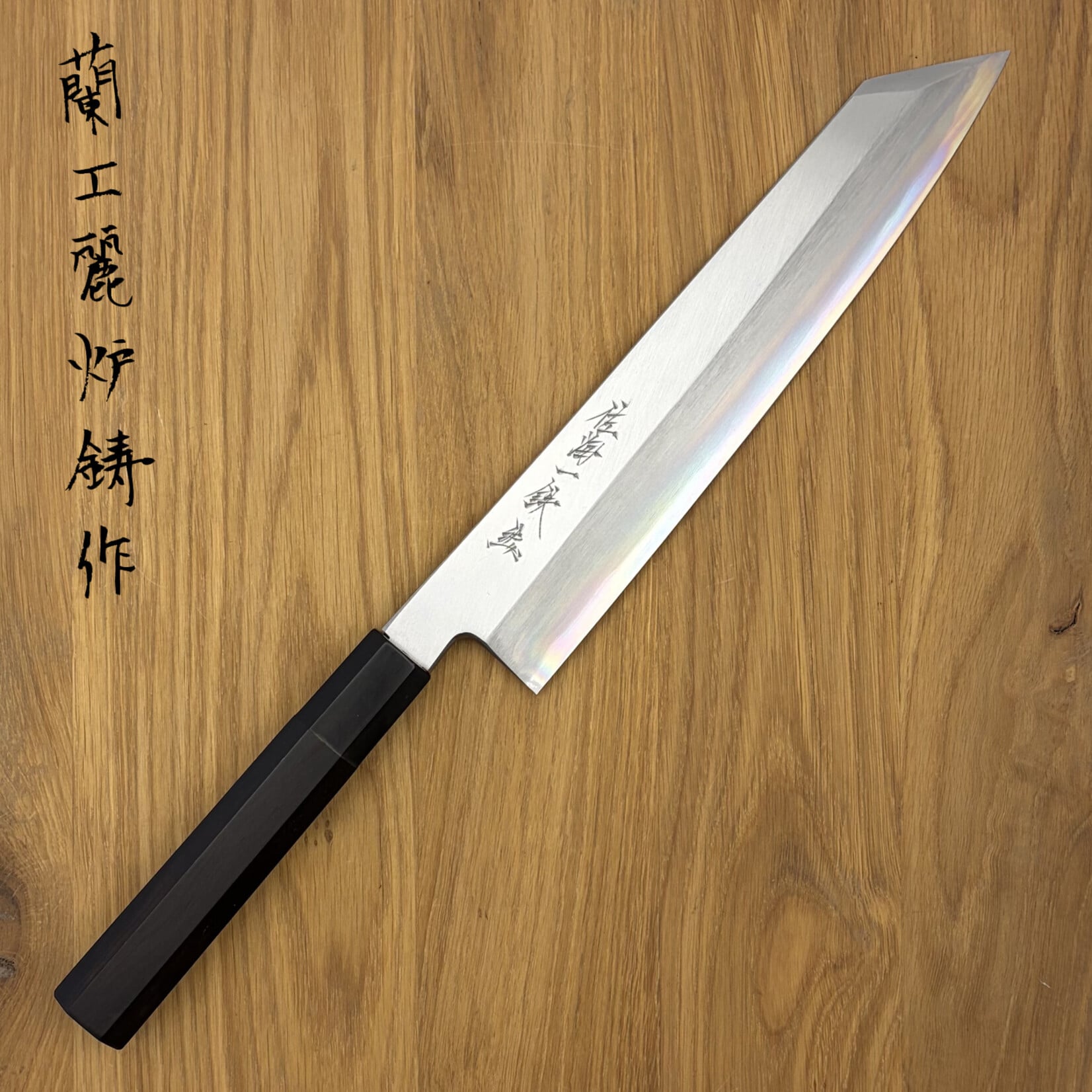
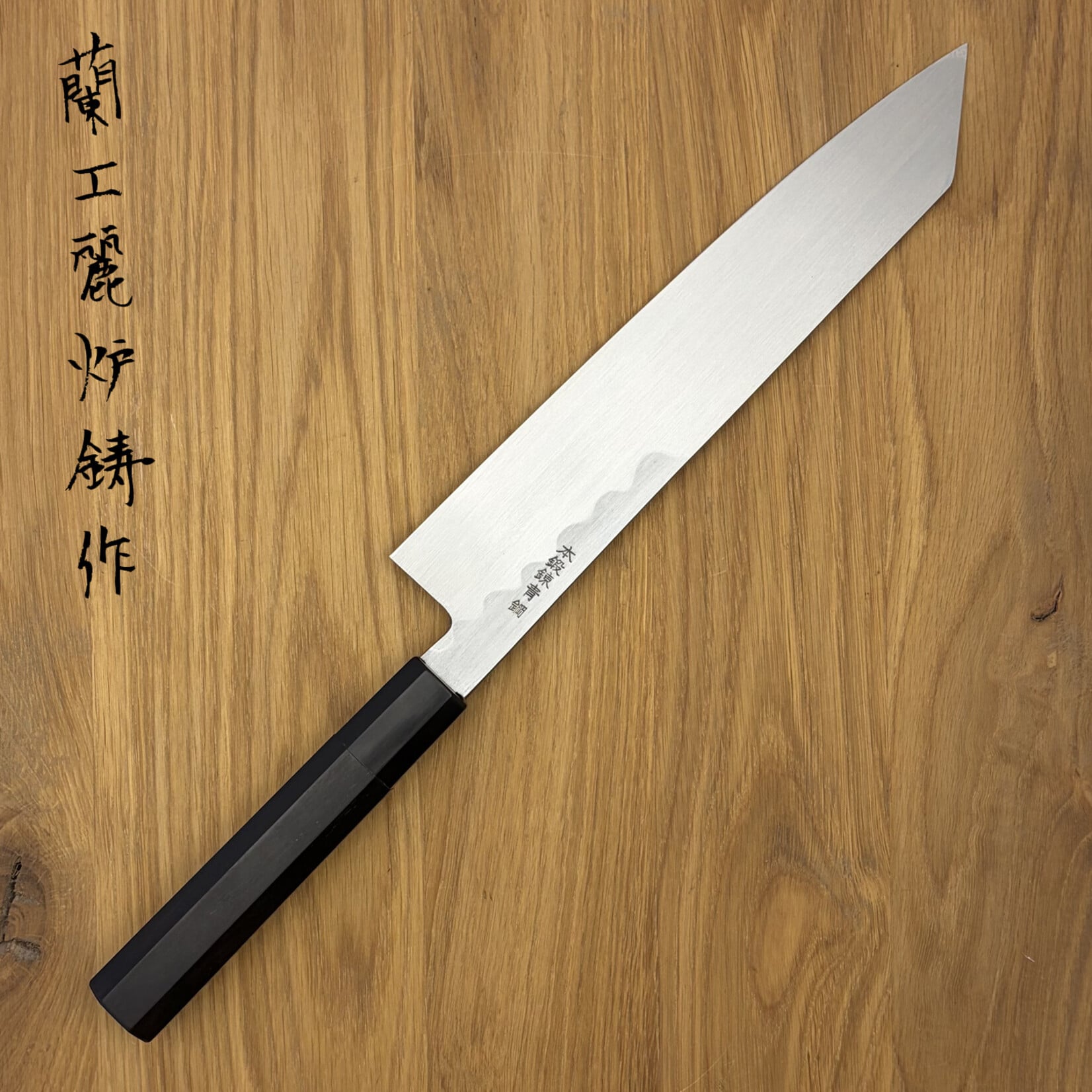
Habahiro-kiritsuke • 240 mm • Blue#2 • ebony handle with dark horn bolster • for right handed use
Features of the Touroku Habahiro
Habahiro translates to "wide blade." As a result, this single-bevel kiritsuke features a taller blade than a standard kiritsuke. The additional blade height provides greater knuckle clearance and improved control while cutting.
This model is highly versatile and well suited for preparing fish, boneless meat and vegetables. The distinctive kiritsuke tip excels at precision work, while the taller habahiro blade is ideal for chopping and making long, smooth slicing cuts. Thanks to its single-bevel geometry, it offers a cutting experience that differs from that of double-bevel knives.
Touroku uses the well-known Blue #2 steel, a traditional high-carbon steel prized for its excellent sharpness and edge retention. As it contains no chromium, the steel is not stainless and requires proper care to prevent rust. The knife is finished with an ebony handle and a buffalo horn ferrule.
Blue steel, also known as Aogami/Aoki steel
This traditional steel is not named after its colour, but named after the colour of its paper wrapping, in which it is stored in the Hitachi steel factory in Japan. There are three different grades: super, #1 en #2. Blue steels use a high grade of carbon, chrome and vanadium added in their alloy. Aogami super even added extra tungsten. Aogami super is here " Best of both worlds" Blue #1 is for sharpness, Blue #2 for toughness. Blue steels are mostly seen in deba or usuba knives, white steels often in yanagibas. Aogami super is regarded as one of the best traditional steels by Japanese knifemakers, but difficult to work with. Blue steels are difficult to sharpen on a whetstone, but they remain sharp for a longer period, compared to white steels.
Elwin de Veld about Touroku
Japanese craftsmen are on a pedestal worldwide. They are known for dedication, passion and the inner drive to continually improve themselves. Their craftsmanship has been passed on and improved for generations, within small, often independent, family businesses. These companies are often spread throughout Japan, where certain regions are known for a certain craftsmanship. Sometimes these small companies are affiliated with a guild, sometimes not. Especially the older small companies (those with the greatest perseverance) are open to contacts outside Japan, but often do not know how to take this step.
Taka san, third-generation owner of Touroku Sakai ( 登録佐海 ), which translates as “Registered or Registered,” aims to connect these businesses and expose their craft to the world. Touroku represents a distinguished group of craftsmen who specialize in making refined Japanese knives and hold on to the knowledge acquired over generations. Taka san has a unique company where he brings together the crafts from the regions of Tsubame Sanjo City, Niigata, Tosa city, Kochi and from the Honkuriku region: Toyama city.
Meanwhile, Touroku knives are loved by many professional chefs worldwide and are embraced by many enthusiastic home cooks